Pages

Showing posts with label 11g. Show all posts

Thursday, September 26, 2013

BI Mobile HD App 11.1.1.7

Finally got around to writing my long overdue post on the new BI Mobile HD app. To get on with it, without much ado, not to loiter, and all that... here goes.

The new BI Mobile HD app, version 11.1.1.7.0.2094, can be downloaded from the Apple iTunes App Store (link to app preview page on iTunes).
If you already have the BI Mobile HD app installed on your iOS device, you should get an App Store notification on the availability of an upgrade. Note, that since this version is available only for iOS version 6 (and above), if you are running an older version of iOS, you will not get a notification, and will not be able to download it. If you check the Wikipedia iPhone page (link) you will see that the iPhone 3GS and later devices support iOS 6. As far as the iPad device goes, if you check the Wikipedia page (link), iPad 2 and later devices support iOS 6.

Wednesday, September 25, 2013

Creating your first app with the BI Mobile App Designer

While creating sophisticated mobile apps that provide a rich feature set takes time, expectedly, what is wonderful about the recently launched Oracle Business Intelligence Mobile App Designer is the fact that you can be up and running without requiring a week-long training and a Master's degree in Computer Engineering.

Here's a short video I recorded on creating your first app with the BI Mobile App Designer (the direct URL on YouTube). A note of caution, and an apology of sorts - the audio in last few seconds of the video dramatically jumps up in volume. This is because I recorded these last few seconds later, and used different audio settings. I should have normalized it. I live, and I learn.


Introduction to the BI Mobile App Designer

Oracle launched a brand new addition to its Business Intelligence Mobile solution - BI Mobile App Designer, which lets you create stunning, interactive mobile apps, literally within minutes. Apps created run on mobile devices running a reasonably modern mobile browser - that can handle HTML5 and jQuery - and are available on both smartphone and tablet form factors.

White spaces and Map Views

When working with Map Views, you can choose to collapse the map formats panel on the left.

When you do that, the panel is hidden, but white space is displayed on either side of the map view, where the panel used to be.

Currently there is no option to remove this white space through a UI setting.

Wednesday, May 08, 2013

Oracle BI Apps 11.1.1.7.1 Available

The latest version of Oracle Business Intelligence Applications, version 11.1.1.7.1, became available for download on the Oracle Technology Network.

You can download the software here.
The documentation library can be accessed here.

Some of the highlights of this release of Oracle BI Apps are:
  • New applications, including Student Information Analytics, that provides an integrated view of admissions and recruiting, student records and student financials. It is certified with PeopleSoft Campus Solutions 9.0 (Bundle # 25),  and Indirect Spend Planning, that enables procurement teams to forecast indirect spend, and use packaged what-if modeling tools to reduce spend.
  • Content enhancements to Financials, HR, Projects, CRM, Procurement and Spend Planning, and Supply Chain & Order Management Applications.
  • New TCO (Total Cost of Ownership) tools, including a GUI based configuration and a functional setup tool.
  • This version of BI Apps is based on the technology infrastructure of the Oracle BI EE 11.1.1.7.0 release.
  • As an optional feature to this release, an enhanced ETL architecture using Oracle Golden Gate is now available.
  • These BI Applications are now available with the next-generational ELT architecture of ODI (Oracle Data Integrator)
A busy season for analytics releases.
Abhinav,
8th May 2013, Bangalore

Friday, May 03, 2013

11.1.1.6.10 Bundle Patch for OBIEE Now Available

Earlier in the week the latest bundle patch for Oracle Business Intelligence Enterprise Edition - 11.1.1.6.10 - became available to Oracle customers on the My Oracle Support portal. "This patchset is available for all customers who are using Oracle Business Intelligence Enterprise Edition 11.1.1.6.0, 11.1.1.6.1, 11.1.1.6.2, 11.1.1.6.2 BP1, 11.1.1.6.4, 11.1.1.6.5, 11.1.1.6.6, 11.1.1.6.7, 11.1.1.6.8, and 11.1.1.6.9."
  1. Oracle Business Intelligence Installer: Tracking Bug 16504136
  2. Oracle Real Time Decisions: Tracking Bug 16504143
  3. Oracle Business Intelligence Publisher: Tracking Bug 16504148
  4. Oracle Business Intelligence ADF Components: Tracking Bug 16504154
  5. EPM Components Installed from BI Installer 11.1.1.6.x: Tracking Bug 16504156
  6. Oracle Business Intelligence: Tracking Bug: 16427939
  7. Oracle Business Intelligence Platform Client Installers and MapViewer: Tracking Bug 16504161
You can search for this patchset on the My Oracle Support portal by using the "Recommended Patch Advisor" and selecting "Oracle Business Intelligence Enterprise Edition" from the "Product" dropdown and "11.1.1.6.0" from the "Release" dropdown. 

This will lead to the search results page listing all the available patches available.


Why are bundle patches recommended? They are recommended because these are a collection of critical bug fixes for a product or specific products. These patches can sometimes also contain minor enhancements as well as security updates. These patches undergo a rigorous set of tests before they are released for consumption by customers. Furthermore, these bundle patches are cumulative in nature, which means a bundle patch contains the contents of previous bundle patches that have been released. 

As always, you should carefully go over the documentation accompanying the bundle patch and come to a considered decision on applying the patch.

Thank you,
Abhinav, 3 May 2013
Bangalore.

Tuesday, April 02, 2013

OBIEE 11.1.1.7.0 Available

The latest release of Oracle Business Intelligence, 11g (11.1.1.7.0) is now available for download from the Oracle Technology Network (OTN). This is a significant release of Oracle BI and has enhancements across the stack.
A few of the more than 200 enhancements are:
  • New visualizations, including the Performance Tile, Waterfall graph, 100 Percent Stacked Bar graph
  • A new Visualizations Suggestion Engine
  • Breadcrumbs for contextual awareness and navigation.
  • Templates support for printing Dashboards
  • Ability to freeze headers when navigating long tables or pivots
  • Hadoop integration in the BI Server, which can now connect to Apache Hadoop data sources, fire off Hive QL queries across federated data sources.
  • Use a new, faceted user interface to search for your web catalog content. Directly launch content with the search criteria passed through as filters/prompts from the search results.
  • A model checker to flag off possible errors or warnings in your model. Can also be invoked via the command line, which makes it easy to automate.
  • Improved document genration performance in BI Publisher
  • A new report wizard in BI Publisher
  • Layout editor enhancements and extensions in BI Publisher
  • Support for local CSV and XML data sources in BI Publisher
  • Create private JDBC connections in BI Publisher
  • A new Smart View add-in with support for the BI Presentation catalog
  • Embed dashboards, with support for dashboard prompts, and analyses using the Smart View add-in
  • Create new analyses using Smart View and save them in your Excel workbook or back to the Presentation Catalog
  • Use BI Publisher to directly report against Presentation Catalog subject areas without having to create data models beforehand
  • Export dashboards to BI Publisher - the data models, layout, (supported) views and formats are carried over.
  • Performance improvements in the Scorecard and Strategy product.
  • Improved dashboard prompt support for Scorecards
  • And much much more...
A few links are in order now.
Over the coming days and weeks there will be a ton of information put out on this release on the Oracle.com site, and disseminated via Twitter, Facebook, YouTube, LinkedIn, and other channels.

Happy downloading and thank you.
Abhinav
Bangalore, April 2, 2013

Tuesday, March 26, 2013

BI Mobile App Update

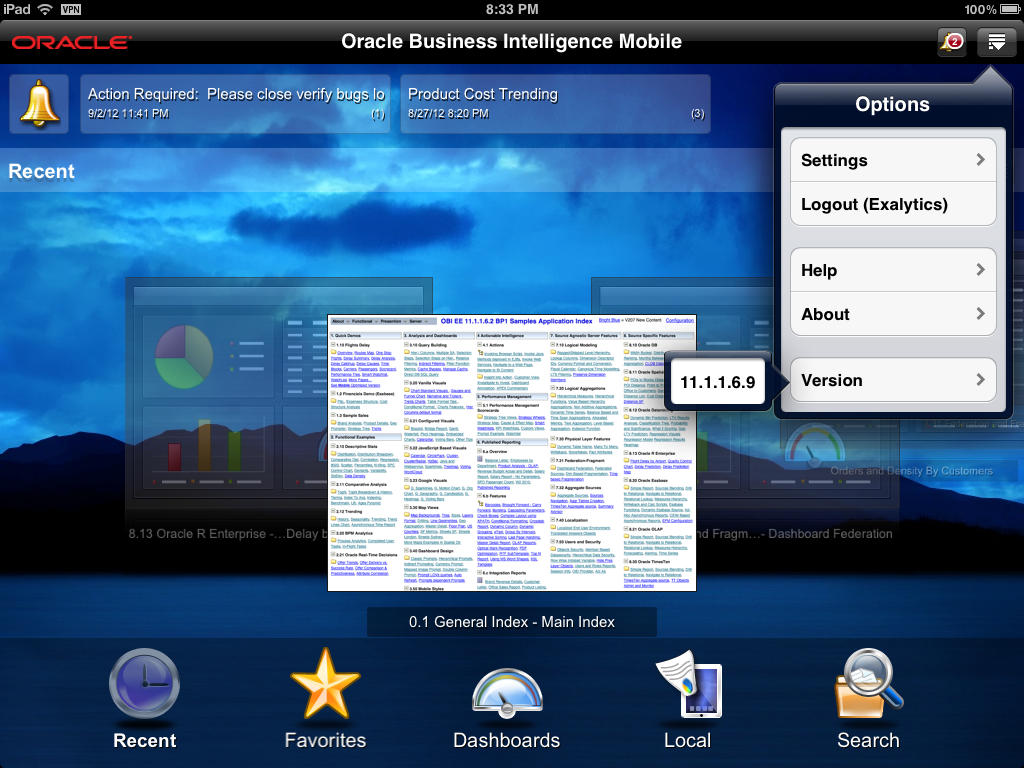
An update to the Oracle Business Intelligence Mobile HD app went live on the Apple iTunes App Store. This is the 11.1.1.6.9.1526 version of the app, and if you already have the Oracle BI Mobile HD app installed on your iPad device, you would have been notified via the App Store app (kind of redundant isn't it - calling it the "app" store "app"?) of the available upgrade.

As far as updates go, this version basically brings in bug and stability fixes, along with two minor enhancements. First, you can now change between landscape and portrait orientation when viewing content, and second, you can now send content as PDF attachments via email.


A new option on the "Settings" screen - "Display" - has been added to let users control how attachments should be displayed when sending them via email - "as Links", "as Attachments", or "as Inline". The "as Links" option basically means no attachment is included with the email, and only links to the content are included in the body of the email. The "as Attachments" option, when selected, adds a sub-option to the "Settings" screen, named "Format", which lets you select whether format of the attachments should be "PDF" or "HTML". The third option - "as Inline" - embeds the content inside the body of the email as rich HTML.


That's all folks.
Abhinav
Bangalore, Mar 26, 2013

Monday, March 18, 2013

OBIEE 11.1.1.6.9 Bundle Patch - 2

The latest bundle patch for Oracle Business Intelligence Enterprise Edition 11.1.1.6.0, 11.1.1.6.9, released a few days back.
Here are some more details on the patch and how to get it from the My Oracle Support site.
First, you can read Document 1536004.1 that provides details on this bundle patch as well as the the constituent patches of this bundle patch:
  1. Patch 16287811 (1 of 7) Oracle Business Intelligence Installer. (generic)
  2. Patch 16287778 (2 of 7) Oracle Real Time Decisions. (generic)
  3. Patch 16237960 (3 of 7) Oracle Business Intelligence Publisher. (generic) 
  4. Patch 16287840 (4 of 7) Oracle Business Intelligence ADF Components. (generic)
  5. Patch 16287854 (5 of 7) Enterprise Performance Management Components Installed from BI Installer 11.1.1.6.x. (port-specific)
  6. Patch 16227549 (6 of 7) Oracle Business Intelligence. (port-specific)
  7. Patch 16287884 (7 of 7) Oracle Business Intelligence Platform Client Installers and MapViewer (generic)
Second, do read the readme file associated with this bundle patch that provides the installation instructions for applying these patches.

Third, this is a cumulative patch, and therefore includes all the fixes included in the 11.1.1.6.2, 11.1.1.6.4, 11.1.1.6.5, 11.1.1.6.6, 11.1.1.6.7 and 11.1.1.6.8 patch sets of the 11.1.1.6.0 release.

Thank you.
Abhinav,
Bangalore, March 18, 2013

Monday, March 11, 2013

OBIEE 11.1.1.6.9 Bundle Patch released

Over the weekend our sustaining engineering team announced the availability of the latest bundle patch for OBIEE 11g - 11.1.1.6.9

I will post more details in a day or so.

A note on bundle patches: They are recommended because these are a collection of critical bug fixes for a product or specific products. These patches can sometimes also contain minor enhancements as well as security updates. These patches undergo a rigorous set of tests before they are released for consumption by customers. Furthermore, these bundle patches are cumulative in nature, which means a bundle patch contains the contents of previous bundle patches that have been released. 

Take care folks.
Abhinav,
Mar 11, 2013, Bangalore

Wednesday, January 30, 2013

OBIEE Bundle Patch 11.1.1.5.5 Available

Bundle Patch 11.1.1.5.5 for Oracle Business Intelligence Enterprise Edition, also known as 11.1.1.5.0 BP5, is now available for download from Oracle Support.

The easiest way to locate this bundle patch on Oracle Support is to search under the "Patches & Updates" tab with the id 15887317 - because that is the id of this patch.
21 bug fixes have been delivered in this bundle patch. Since bundle patches are cumulative, it also contains bug fixes from the earlier updates, including 11.1.1.5.0PS111.1.1.5.0BP2, 11.1.1.5.0BP3, and 11.1.1.5.0BP4

Furthermore, this bundle patch is available for the following eight platforms:
  • Microsoft Windows (32-bit) 
  • Microsoft Windows x64 (64-bit) 
  • Linux x86 (32-bit) 
  • Linux x86-64 (64-bit) 
  • Oracle Solaris on SPARC (64-bit) 
  • Oracle Solaris on x86-64 (64-bit) 
  • IBM AIX PPC (64-bit) 
  • HPUX- IA (64-bit) 


Why are bundle patches recommended? They are recommended because these are a collection of critical bug fixes for a product or specific products. These patches can sometimes also contain minor enhancements as well as security updates. These patches undergo a rigorous set of tests before they are released for consumption by customers. Furthermore, these bundle patches are cumulative in nature, which means a bundle patch contains the contents of previous bundle patches that have been released. Therefore, to take a simple example, if you are on version 11.1.1.5.0, you do not have to install any of the bundle patches that have released since, and can apply bundle patch 11.1.1.5.5, secure in the knowledge that this bundle patch contains all the updates that went into bundle patch 11.1.1.5.4, which in turn contained all the fixes that went into bundle patch 11.1.1.5.3, and so on and so forth.

As always, you should carefully go over the documentation accompanying the bundle patch and come to a considered decision on applying the patch.

Thank you.
Abhinav,
30 Jan, 2013
Bangalore

Wednesday, December 12, 2012

OBIEE Infrastructure Tuning Whitepaper

The Oracle BI / EPM Product Assurance Engineering Team have published an updated version of their whitepaper, "Best Practices Guide for Infrastructure Tuning Oracle® Business Intelligence Enterprise Edition 11g Release 1 (11.1.1.5, 11.1.1.6)" (see blog post). This has been updated to include version 11.1.1.6 of Oracle Business Intelligence.
Best Practices Guide for Infrastructure Tuning Oracle® Business Intelligence Enterprise Edition 11g Release 1 (11.1.1.5, 11.1.1.6)
The first paragraph of the whitepaper describes who this document is intended for:
"This document is written for people who monitor performance and tune the components in a BI environment. It is assumed that readers know server administration, Oracle® Fusion Middleware (FMW), hardware performance tuning fundamentals, web servers, java application servers and database."

And, do note the disclaimer:
"Disclaimer: All tuning information stated in this guide is only for orientation, every modification has to be tested and its impact should be monitored and analyzed. Before implementing any of the tuning settings, it is recommended to carry out end to end performance testing that will also include to obtain baseline performance data for the default configurations, make incremental changes to the tuning settings and then collect performance data. Otherwise it may worse the system performance."

Happy reading.
Abhinav
12.12.12 (yes, another reason to post this today)
Bangalore

Thursday, December 06, 2012

Book Review - Oracle BI 11g Developer’s Guide, by Mark Rittman


Oracle Business Intelligence 11g Developer’s Guide, by Mark Rittman
(Amazon USKindle-US)

Writing a book on the Oracle Business Intelligence suite is a tall order. At more than a thousand pages, this book measures up to the task, literally, and as you will read this book - figuratively also.

So, have I read the entire book? No. I have not. It is close to 1100 pages long, and I have read parts of it, and skimmed through much of the remainder. Why am I writing this review before I have read the entire book then, eh? Well, to be honest, reading the entire book is going to take longer than I thought. I have had this electronic version of the book for several weeks now, and I was starting to feel like I should put something out lest I let the year end and a new year begin. For what it's worth, I do hope to keep adding new posts as I read through the unread portions of the book. So take this as a caveat. Anything else? Yes, one more, though more of a disclosure.

Disclaimer: I received a free e-book version of this book, courtesy Mc-Graw Hill, and thanks to Mark Rittman. I also, separately, and later, obtained access to an online version of this book via a subscription to Safari Books Online (http://techbus.safaribooksonline.com/).
Also note that I am reviewing this book in my personal capacity, and not representing Oracle in any way. 

Anything else? Yes, one more disclosure. I am a product manager with the Oracle Business Intelligence group, and have worked to bring some of the products and features covered in this book. That is guaranteed to bias my review, in what ways I don't know. Read and let me know.

So who is this book aimed at? Everyone. No, really. Everyone working with Oracle's BI toolset, to be sure. This includes people who have worked with the 10g version and expect to, if haven't already, moved to 11g. It includes people with such roles as administrators, metadata modellers, report authors, dashboard authors, and more. This is basically the big kahuna.

This book adopts a bottom-up approach, which is quite the sensible thing to do when organizing a book for the business intelligence developer. While talking about and presenting to an audience, I have found it useful to adopt a top-down approach, since it makes the audience understand how something they see has being built, that approach is likely to confuse and frustrate the developer. So, the book literally starts with the installation pre-requisites - yes, what you need to install before you install the Oracle BI software. The first hundred pages of the book are spent in covering the basics of business intelligence, how the product came into being, what it is composed of, and the installation.


Each subsequent chapter can be looked at both thematically and from a product perspective. So, for example, Chapter 3, "Modeling Repositories Using Relational, File, and XML Sources", and Chapter 4, "Creating Repositories from Oracle Essbase and Other OLAP Data Sources" cover how to model the metadata repository - as a theme. As a product, these two chapters are focused much on the "Admin Tool". Chapter 6, "Creating Analyses, Dashboards, KPIs and Scorecards", is all about creating the analytic content that end-users will work with, and it covers the Answers, Interactive Dashboards, and the Scorecard and Strategy Management (OSSM) products.

1        Oracle Business Intelligence Overview and Architecture  
2         Installation and Upgrading Oracle Business Intelligence  
3         Modeling Repositories Using Relational, File, and XML Sources  
4         Creating Repositories from Oracle Essbase and Other OLAP Data Sources  
5         Configuring and Maintaining the Oracle BI Server  
6         Creating Analyses, Dashboards, KPIs and Scorecards  
7         Actionable Intelligence  
8         Security  
9         Creating Published Reports
10         Systems Management
11         Managing Change
12         Oracle Exalytics In-Memory Machine


The 11g release of Oracle BI EE was a big, major, big upgrade from the previous 10g version. Several "things" got added, several things got changed, many pieces in the plumbing changed, and in general, it fulfilled all requirements of being a big release. The install procedure changed. The underlying middleware changed. The way security worked changed. New products got added to the suite. New capabilities. New products integrated with the suite. A new charting engine for instance. It is therefore heartening to see that the section titled, "Upgrading the 10g Repository (RPD) and 10g Web Catalog (Presentation Catalog)", covers this topic in detail, while also describing "What Happens During the RPD and Catalog Upgrade?", and listing some of the more common error messages and suggested resolutions.

So it comes to pass that Chapter 3, "Modeling Repositories Using Relational, File, and XML", starts at page 101. This is really the chapter that many will actually want to start with straightaway. Within this chapter, there is an example that is worked through, "Example: Creating the Oracle BI Repository", which should make it simple for users to follow through and try on their own. Apart from the expected, introductory material, you will also find coverage of the Aggregate Persistence feature, which is one of the key enablers of Exalytics, of "Advanced Repository Modeling Concepts", which describes how to create skip-level as well as ragged hiearchies, federation (cross-database modelling). For those wanting details on mulit-dimensional data modeling, fear not, worry not, because Chapter 4, "Creating Repositories from Oracle Essbase and Other OLAP Data Sources", is exactly what the data doctor ordered. In case you didn't know, Oracle BI supports four different OLAP data sources, including Oracle Essbase, Oracle Database OLAP Option, SAP BW, and Analysis Services. While some years ago, OLAP was a sine-qua-non for achieving high-performance querying on large datasets, advances like in-memory databases (like Times Ten), massive amounts of memory (think terabytes of RAM, not gigabytes), engineered systems (like Oracle Exalytics and Oracle Exadata), as well as continuing improvements to data warehousing technologies have meant that ever-faster performance can be achieved on ever-larger databases. In this chapter, I think the most space is devoted to Essbase. The last chapter in this section is chapter 5, "Configuring and Maintaining the Oracle BI Server", which, as you would expect, treads the areas like the configuration settings (the NQSConfig.INI file) - some that are manually maintained while others can be managed via Enterprise Manager. Also along for the ride are topics like managing the Query Cache, Usage Tracking (important topic, as you would expect), Aggregate Persistence - also an important topic.

If you are an Oracle BI developer who works more on the front-end, i.e., develop reports and Dashboards, then Chapter 6, "Creating Analyses, Dashboards, KPIs and Scorecards", is the one for you. It's a long chapter, as it needs to be, since you cover the Answers, Interactive Dashboards, and the Scorecard and Strategy Management products. This chapter is a long one, as it needs to be, and starts out with the Answers product, and goes through the basics of creating analyses, from the criteria tab, editing formulae, creating views - like graphs, tables, etc... On the subject of graphs, one trick that I think Mark missed out is that the images and screenshots in the ebook version - I don't know about the physical book - are in grayscale, and not distinguishable from each other. Colors with different brightness levels would have worked better. Yeah, you can tell, can't you, I work with data visualizations.


A bane of writing books for software applications is that often a new product comes out by the time the book goes to market, and thus some things are already out of date. Mark has done a tremendous job of keeping up with the various releases of Oracle BI EE as he wrote his book, but in some cases a few things fell through the cracks, I think. Like with spatial data visualizations, or Map Views, as they are called in the Oracle BI suite. First, some of the interaction designs were cleaned up in Map Views, so they look much cleaner. The screenshot for a map view I spotted was from an older release:
Secondly, the 11.1.1.6.0 release introduced support for "feature themes" in Map Views. Feature themes are simply spatial themes, imported into the BI metadata, but which do not have any keys that can be mapped to BI columns from your repository. I will write a detailed post on Feature Themes later, but it is a useful feature if you plan on using Map Views in your application.
Thirdly, the 11.1.1.6.2BP1 release also introduced support for line geometries - a third type of spatial geometry, the other two being polygons and points. Then there are some minor but useful enhancements like the ability to specify a transparency level for color fills. Small things that are easy enough to miss in all the releases and updates that happen in the world of Oracle BI. Perhaps Mark would consider an ebook update sometime in 2013 to his book?

You may think, as you go over Chapter 6, that the area of  the "Action Framework", a major new feature in the 11g release, has been given short shrift. Far from it - there is an entire chapter devoted to it - Chapter 7, "Actionable Intelligence". And for good reason - there is much to be covered in Actions, that can be created and configured to do simple things like navigate to a URL, or open content from your BI catalog, but also very powerful things like invoke a web service, a Java method, a server script, an HTTP request, and so on. The premise of the Action Framework is to help close the Insight-to-Action loop, i.e. from a Dashboard, where insight is gained, allow the analyst to take action based on this insight by invoking the appropriate Action.

How security works in the 11g release of Oracle BI underwent a major revamp. It is very important, if you are working with building the appropriate access privileges and configuring security in Oracle BI that you read Chapter 8, "Security", very carefully. Pay careful attention to the section, "Understanding Oracle Business Intelligence Security Infrastructure, Application Roles, and Application Policies", as well as the sections that follow.

Chapter 9, "Creating Published Reports", is all about Oracle BI Publisher. Another chapter to read carefully if you work with or have worked with the tool in its 10g release. This is another product in the suite that has undergone several major enhancements - whether it is how you construct the data model, or the Online Layout Editor (a replacement for the Template Builder for Microsoft Word plug-in), or even the enhanced level of integration with Oracle BI, especially in how BI Publisher reports can be embedded inside Dashboards.

If you are a serious Oracle BI developer, then at some point in your BI implementations you will need to deal with issues like change management, how to implement multi-user development (also referred to by the singularly glamorous acronym of MUD), how to move your metadata from one instance to another, and how to use version control tools with your Oracle BI metadata. Chapter 11, "Managing Change" (though this chapter title could also work just as well for the title of some management guru's book), is the chapter for you.

Chapter 12, "Oracle Exalytics In-Memory Machine", serves as an introduction to Oracle Exalytics, the latest addition to Oracle's family of engineered systems. At the time this book went to press, a final decision had not been taken, or communicated, as to which of these features would finally make it to the release. Hence a disclaimer in the chapter. So there is only a mention in passing on multi-panel visualizations, Trellis views - both the Simple and Advanced Trellis, as well as a visualization available within the Trellis View - microcharts, available as SparkLines, SparkBars, and SparkAreas. And on "go-less" prompts, and "autocomplete" prompts. As things stand, all of these features are available with the Oracle BI EE 11.1.1.6.2BP release - both as "software-only" and on Exalytics.

You should have gathered this much, if nothing else from my review so far, that this book is not meant for the casual user of Oracle Business Intelligence. You will be better served by perusing the several useful blogs that dot the interwebs. This book is meant for the serious BI developer, who needs to know the nuts and bolts of the Oracle Business Intelligence suite.

So all is good and exciting? Yes. Mostly. Mostly? So what did I not like about this book?
Well, let's get one thing right - this is an excellent book, and I daresay every Oracle BI consultant out there will end up buying, borrowing, or sharing a copy of this book. On the other hand, I can get crotchety and nitpicky at times. So let's continue the cribfest.

Firstly, I did spot a few errors; minor ones. For instance, on page 13, Mark writes that "Oracle announced in 2005 that what was previously called Siebel Analytics would now be adopted by Oracle Corporation as their strategic business intelligence platform..." The product name was actually "Siebel Business Analytics", and the decision was actually taken in early 2006, and communicated, first, to the business intelligence development teams, and then to other groups within Oracle. In December 2005, if memory serves me right, a technical evaluation of the Siebel Business Analytics stack had begun in earnest, and a recommendation was formulated. The external communication of this decision was sometime in March 2006, at an event held in New York. Or that "the core of the product itself can be traced back to groundbreaking work done by the nQuire team back in the mid-1990’s." - nQuire started in 1999, and released their first version in 2001, and were acquired by Siebel in 2002/2003.
These are minor quibbles, and the precise dates of how nQuire and Siebel Business Analytics came to be Oracle BI are at best of historical interest at this point.
Or when the text says, "Oracle BI Office Oracle Business Intelligence comes with a plug-in to Microsoft Office 2003, 2007, and Oracle Office..." - there is actually a separate plug-in for Oracle Office. The Oracle BI Office Add-in cannot install on Oracle Office, nor does it work with Oracle Office. The paragraph also left out mention of the Smart View plug-in that comes with the ability to connect to the Oracle BI Server - it is admittedly basic functionality, and it is not part of the Oracle BI EE suite, so it may be ok to leave its mention out.

You will find almost no coverage of the Oracle BI Office Add-in, the Microsoft Office plug-in for Oracle BI EE, available for Microsoft Excel and PowerPoint. Nor of Smart View. While Oracle has communicated that its long-term strategy is to build out the analysis and integration capabilities of Smart View to access Oracle BI EE content, the Oracle BI Office Add-in continues to provide support for embedding and analyzing Oracle BI content.

The Oracle BI Mobile product also finds little mention. The 11.1.1.5.0 release of the Oracle BI Mobile product is covered, but the more substantive, and more functional release came with the release of the Oracle BI Mobile HD app for Apple iPad, which introduced much greater support for touch-based interactions, location intelligence support, true-fidelity rendering of Scorecard views as HTML5 components,  and much more. Again, this is more a limitation of deadlines - the book, I gather, had to go to print by the time the 11.1.1.6.2BP1 release was going out the door.
Perhaps Mark will consider doing an ebook or online update to this book and include these topics.

The other issue, and perhaps the more substantive one, is that while the book is a veritable goldmine of information once you know Oracle BI, for the completely newcomer, it's a bit daunting. Perhaps some sort of a visual layout of how the book is organized - color coded perhaps - and an indicator at the beginning of each chapter or major section showing which part of the suite and functionality it covered would have eased the job of the newbie. It's a subjective opinion, but hey - as long as we're being negative, let's go the whole hog.

In closing, and after having spent a few hours with the book, I can say it's a mammoth effort that brings, perhaps for the first time in one complete book, all the resources that an Oracle BI developer could want. In short, an indispensable guide for the business intelligence developer.

ISBN: 978-0-07-179875-4
MHID: 0-07-179875-7
ISBN: 978-0-07-179874-7
MHID: 0-07-179874-9.

Kindle Excerpt:


Thursday, November 15, 2012

Author Podcast - Mark Rittman

Oracle Business Intelligence 11g Developers GuideAs part of the Oracle Author Podcasts, Paul Rodwick, VP of Oracle BI Product Management, spoke with Mark Rittman, author of the recently released Oracle Business Intelligence 11g Developers Guide. It is a massive tome, coming in at just under 1100 pages. I have been reading it, and hope to have a review up in a week or two, but in the meantime, peruse this informative podcast.

McGraw-Hill: Oracle Business Intelligence 11g Developers Guide : Book
Chapter One
Kindle e-book, Amazon, Amazon UK

Kindle Excerpt:


Monday, November 12, 2012

Oracle BI Mobile Security Toolkit

The Oracle BI Mobile Security Toolkit, version 11.1.1.6.2 .1272, for Apple iPad (iOS 5 and iOS 6) is now available for download from the Oracle Technology Network here (http://www.oracle.com/technetwork/middleware/bi-enterprise-edition/downloads/bi-mobile-security-toolkit-1872818.html).

Heh? What's that?
Here's the short blog post explaining what (my personal take, with lots and lots of help from our super PMs and development team working on this, of course!).


The Oracle BI Mobile Security Toolkit "provides the ability to generate a signed version of the Oracle BI Mobile HD application. The toolkit includes the instructions and necessary content to build this application making use of Apple’s Xcode and the IOS SDKs."

What this basically means is that this allows you - the customer - to take an unsigned, unpacked version of the Oracle BI Mobile app, and combine it with the third-party mobile security vendor of your choice to create a secure, containerized version of the Oracle BI Mobile that can then be managed with the mobile device management solution that you - the customer - choose. There are some restrictions and caveats, of course, but in a nutshell that's the premise of this toolkit.

This - additional layer of security - is important because mobile devices present a new challenge in terms of security and device management. With more and more business information being delivered to mobile devices like smartphones, even more pertinent for businesses - to tablets, and more and more business information being stored on tablets, companies have a vested interest in ensuring that these tablets can be managed by their IT departments, that the data when stored on these devices can be secured, and should a device be misplaced, any business applications and data stored on those devices be wiped, remotely if needed, and deleted by IT. As the oft-repeated cliche goes, your company's business data and IP walks out the door every time your employee carries a smartphone or tablet, with your company's apps and data on them, out the door. It is in your business interests to secure and protect that data.

While mobile apps like Oracle BI Mobile have several mechanisms to provide multiple levels of security - support for SSL, Single Sign-On, VPN, fine-grained access controls, control over offline storage of data, and more - some aspects like device management are best done by device management solutions since they allow an IT department to formulate and enforce policies across the board for all apps that their employees download on to their tablets.

So what does the toolkit do? It allows third-party vendors to generate signed secure versions of the Oracle BI Mobile app.

So what are some of the capabilities that a third-party device management's software provide that may be of interest to a customer? Apart from the BI Mobile app's own security features, a third-party MDM vendor could provide such features as geo-fencing (i.e. allow the app or selected apps to be operable only within a specified geographic area, and to either warn or disable access to the app should the user venture outside the specified area), improved encryption (for instance, enforce the encryption of the Oracle BI Mobile app's offline data at all times, or specify a different encryption algorithm), local data management (set policies for ensuring that old data is deleted from the device after a certain period), data wipe (a data wipe can be initiated remotely by an IT administrator that wipes all data from a specified app, or apps, or in some cases from the entire device itself).

A key benefit - for some customers - is "containerization". Containerization basically wraps the target app, in this case, for example, the Oracle BI Mobile app, within a container, that err, contains, a proprietary set of networking APIs, so that all network traffic - mostly HTTP and HTTPS, but also other protocols, depending on the vendor - from the target app to the container's networking APIs, so that an additional layer of security and verification can be implemented. You may recall that BlackBerry messenger services have employed such an approach, with great success over many years, and indeed, theirs has been an approach that other vendors have adopted when building enterprise security solutions for mobile platforms.

The download link for the Oracle Business Intelligence Mobile Security Tool Kit is available from the Software Downloads page of the Oracle Technology Network (see screenshot below).
Software Downloads on OTN

Alternatively, you can directly click this link http://goo.gl/up4PA to go to the download page (the direct link - http://www.oracle.com/technetwork/middleware/bi-enterprise-edition/downloads/bi-mobile-security-toolkit-1872818.html - in case the URL shortening service stops working). You have to click to accept the "OTN License Agreement", and then download the 25MB toolkit.
Download Page for the Oracle BI Mobile Security Tool Kit
There is a readMe.txt in the toolkit that outlines what you need to do to create a project using the app bundled with the toolkit.

Finally, note a few additional things.
First, there are some licensing restrictions that define what you can and what you cannot do with respect to customizations.
Second, this toolkit is delivered free of charge to you as customers. That also means that all other licensing requirements of using the Oracle BI Mobile app continue to apply.
Basically, please be sure to read all relevant material as it applies to your usage of the Oracle BI Mobile app and this toolkit - in case of doubts, please contact your Oracle contact to get these clarified. And yes - this is a disclaimer - please use this post only for general information, and do not take anything written here to be official Oracle policy. In case of doubt, check with your Oracle representative.


That's all folks. Take care.
Abhinav
Nov 12, 2012
Bangalore

Thursday, October 18, 2012

New Maps OBE

Building Maps for Oracle Business Intelligence Analyses and Dashboard - This is a new OBE ("Oracle By Learning") available from the Oracle Learning Library, and it walks you from soup to nuts (is that the right expression? Yes, it is). I.e., from importing a small spatial dataset into the Oracle Database, and then working with it in MapBuilder, defining the datasource in MapViewer, and then moving on to Oracle Business Intelligence, importing this metadata, and finally using it in a Map View inside an analysis.

Go take a look - it's very useful.

Take care, and bye for now.
Abhinav
Oct 18, 2012.
Bangalore

Monday, September 10, 2012

Oracle BI Mobile HD App - 3

To continue from an earlier post of mine (Oracle BI Mobile HD App - 2), I will look at other ways of interacting with data on views. To recap, in that post, which would be , I talked about the support for tooltips via a tap gesture and draggable tooltips via the tap-and-drag gesture.

In this post, let us take a brief look at some of the other interactions available on views like the Table and Pivot and Trellis (yes, I used a conjunction where a comma should have been).
 
When interacting with a Pivot View, for instance, you can use the mouse right-click to view the interactions available. The section, Right-Click Menu for Tables, Pivot Tables, and Trellises, from the "Oracle® Fusion Middleware User's Guide for Oracle Business Intelligence Enterprise Edition" doc guide says this about right-click interactions:

"The interactions that are available when you right-click in a table, pivot table, or trellis depend on:
  • The type of data view
  • The data that you have selected data. When you right-click a:
    • Column heading, the available right-click interactions are related to that column, for example, Exclude column or Show Subtotal.
    • Member, the available right-click interactions are related to that member, for example, Expand and Create Group. Interactions that are related to the column that contains the member are also available.
  • Whether you are working in design mode (for example, in the Analysis editor), in a dashboard, or in run-time mode"

More than thirty interactions are available, and these are of great value to Dashboard users, who have greater ways to analyze their data.
Right-click interactions in a Pivot View

These right-click interactions are available via the tap-and-hold gesture in the BI Mobile app. Therefore, if you were to tap-and-hold the "2009" value in the pivot view below, a menu is displayed that contains the same interactions as in the desktop browser mode.

Similarly, if you were to right-click the a value on the left-edge of the Pivot View, you get an even richer array of interaction options, including multi-dimensional analysis options like "Keep Only", "Remove", "Keep Only Related", and more. Since these options could get numerous, these are organized into sub-menus; so if you tap the "Sort" option, you would get options like "Sort Ascending", "Sort Descending", "Add Ascending Sort", "Sort Descending Sort", "Clear All Sorts".


And what about Table views? Since you cannot really do any pivoting, since this is a Table view and not a Pivot view that we are talking about, the choice of interactions is necessarily limited. However, you can choose to exclude this column from your view, or move this column to the Section or Page edge, which can come in handy if you need to look at a subset of your data.


The Trellis View is a new view in the 11.1.1.6.2BP1 release, so let's spend a minute talking about the good Trellis view also. Many, but not all, of the interactions you saw in the Pivot View are also available for the Trellis view, as can be seen in the screenshot below. Again, the tap-and-hold gesture is what is needed.

I apologize for the brevity of this post, but I struggle with some other tasks at work, but I promise a longer post very soon.

Take care, and have a good week.
Abhinav
10 Sep 2012, Bangalore

Previous Posts on the Oracle BI EE 11.1.1.6.2BP1 Release: (or simply use this tag: 11.1.1.6.2BP1 to find all posts for this release)

Thursday, August 16, 2012

Certification Matrix for 11.1.1.6.2BP1

The Oracle Fusion Middleware Supported System Configurations page has been updated with the "System Requirements and Supported Platforms for Oracle Business Intelligence Suite Enterprise Edition 11gR1" (aka SR&SP) for the 11.1.1.6.2BP1 release. It is available as a Microsoft Excel spreadsheet, and can be directly downloaded here.
Screenshot of SR SP Certification Matrix for Oracle BI

Wednesday, August 08, 2012

New Oracle BI Book Due Shortly

Mark Rittman, longtime Oracle expert, consultant, and now soon-to-be author, tweeted that the book he has been working on for some time, Oracle Business Intelligence 11g Developers Guide, should be "out soon", now that it has completed edits and final proofs. It promises to be an interesting read, and given its scope of coverage, I expect it to find its place on many an Oracle BI developer's desk.

It doesn't look like the book will be available in an ebook format like the Kindle, which is a pity. A 900 page book would be much more convenient to carry in bits-and-bytes I expect.


Friday, August 03, 2012

Oracle BI Mobile at the Speed of Thought

There is a new video available on the Oracle web site that showcases the new Oracle BI Mobile application for the 11.1.1.6.2BP1 release.

Here is the link: http://medianetwork.oracle.com/video/player/1730810620001

This is a short three-minute video that takes you on a fast-tour of the new Oracle Business Intelligence Mobile app for the Oracle BI EE 11.1.1.6.2BP1 release. I have been blogging about this release and this app for the past couple of weeks, and this video, produced jointly by our marketing and product management teams, put together a very neat and informative tour of the capabilities in the app and the release.


There is a link provided in the video for more information. And you can always get the app from the Apple iTunes App Store, the software bits from either the Oracle Software Delivery Cloud or from the Oracle Technology Network (Note: you will need to get the 11.1.1.6.2BP1 patch from Oracle Support)

And as I blogged yesterday (I am in Bangalore, ergo), you could try the new version of the Sample App to give the new release a spin, courtesy a Virtual Box Virtual Image, with all the software and data installed and pre-configured. Plug-and-play comes to enterprise software samples!

All posts on the 11.1.1.6.2BP1 release.


Bangalore, August 3, 2012