Pages

Showing posts with label Oracle. Show all posts

Friday, April 07, 2017

Oracle Looking to Buy Accenture? Stranger Things Have Happened.

Image credit: pixels.com
The Register reported that Oracle may be exploring the "feasibility of buying multi-billion dollar consultancy Accenture."

To summarize the numbers involved here, Oracle had FY16 revenues of $37 billion, net income of $8.9 billion, and a market cap of $180 billion.

On the other hand, Accenture had FY16 revenues of US$34.8 billion, net income of $4.1 billion, and a market cap of $77 billion.

Some questions that come to mind:
  1. Why? Oracle buying NetSuite in 2016 made sense. Oracle buying Salesforce would make even more sense. Oracle buying a management consulting and professional services company, and that too one with more than a quarter million employees, on the face of it, makes little sense. Would it help Oracle leapfrog Amazon's AWS cloud business? Would it help Oracle go after a new market segment? The answers are not clear, at all.
  2. Who would be in charge of this combined entity? Both have similar revenues, though Accenture has a market cap that is less than half Oracle's and a workforce that is roughly three times Oracle's. The cultural meshing itself would prove to be a challenge. Mark Hurd, one of two CEOs of Oracle (the other CEO is Safra Catz, a former investment banker), has the experience running a large, heterogeneous organization. Prior to his stint at Oracle, he was credited with making the HP and Compaq merger work. At Oracle, however, he has not run software product development, which has been run by Thomas Kurian, and who reports to Larry Ellison, and not Hurd. A merger between Oracle and Accenture would place an even greater emphasis on synergies between Oracle's software division and Accenture's consulting business.
  3. Oracle would need to spend close to $100 billion to buy Accenture, if it does. How would it finance it, even assuming it spends all its $68 billion in cash to do so? Keep in mind that its largest acquisition was in the range of $10 billion. The financial engineering would be staggering. It helps that it has a former investment banker as one of two CEOs.
  4. Will Oracle make Accenture focus on the Oracle red stack of software products and applications - both on-premise and in the cloud? If yes, it would need a much smaller-sized workforce than Accenture has. That in turn would diminish the value of Accenture to Oracle, and make the likely sticker price of $100 billion look even costlier.
  5. Is Oracle looking to become the IBM of the twenty-first century? It's certainly been a public ambition of Larry Ellison. In 2009, he said he wanted to pattern Oracle after Thomas Watson Jr's IBM, "combining both hardware and software systems." If Oracle keeps Accenture as a business unit free to pursue non-Oracle deals, does it mean Oracle is keen on morphing into a modern-day avatar of IBM and IBM Global Services, offering hardware, software, and professional services - all under one red, roof?
  6. Is Oracle serious about such a merger? An acquisition of this size seems more conjecture than in the realms of possibility, at least as of now. One is reminded of the time in 2003 when Microsoft explored the possibility of buying SAP. Those discussions went nowhere, and the idea was dropped. Combining two behemoths is no easy task, even for a company like Oracle, that has stitched together almost 50 acquisitions in just the last five years.
  7. If such an acquisition did go through, there would likely be few anti-trust concerns. That's a big "if".
  8. Stranger things have happened in the software industry, like HP buying Autonomy.
  9. I hope the Register piece was not an example of an early April Fool's joke.
(HT Sangram Aglave whose LinkedIn post alerted me to this article)

I first published this in LinkedIn Pulse on April 1, 2017.

© 2017, Abhinav Agarwal.

Monday, April 02, 2012

OBIEE 11g Book

There is a new book on Oracle Business Intelligence 11g that is due out later this year - in August 2012, as per the publisher's web site (Packt Publishing Technical & IT Book and eBook Store), titled, " Oracle Business Intelligence Enterprise Edition 11g: A Hands-On Tutorial ", and authored by three OBIEE experts, Christian Screen, Haroun Khan, Adrian Ward.
Adrian Ward, co-author, and long-time Oracle BI user, developer, and consultant, emailed me a few days back, which is how I got to know of this new book coming out, and asked if I would mention the book on this blog. I agreed, since books on Oracle Business Intelligence, the leading, integrated, and best-in-class business intelligence suite in the market, are always welcome.
Adrian also told me this book is "aimed at relative beginners who need a good grounding without too many techie details."
More importantly, for would-be readers, "It's based on 11.1.1.6 and uses a tennis stats database as hands on guide.  All the code will eb available as well." As you know, the 11.1.1.6 release is the latest release from Oracle Business Intelligence, and is also the software release for the Exalytics In-Memory Machine from Oracle. It would be very helpful for readers if this book contains at least a chapter on Exalytics - configuration and optimizations for example.

As of writing this post there is not much additional information available about the book - neither the Amazon book page nor the publisher's site have a table of contents or a sample chapter download available; I suppose that will change as the book nears publication.

In the meantime here are three links for the book:
http://www.obi11gbook.com/ - a site dedicated to the book
Packt Publishing - The publisher's page for the book
Oracle Business Intelligence Enterprise Edition 11g: A Hands-On Tutorial - Amazon's page for the book.


Monday, October 03, 2011

Oracle Exalytics Business Intelligence Machine

The following is intended to outline our general product direction. It is intended for information purposes only, and may not be incorporated into any contract. It is not a commitment to deliver any material, code, or functionality, and should not be relied upon in making purchasing decisions.
The development, release, and timing of any features or functionality described for Oracle’s products remains at the sole discretion of Oracle.

Here's some information on the "Oracle Exalytics Business Intelligence Machine" that was announced by Oracle CEO Larry Ellison at its conference, Oracle OpenWorld, in San Francisco.

  • "The Exalytics machine includes 40 processor cores and 1TB of DRAM, but can hold five to 10TB of data in memory thanks to compression, Ellison said." (link)
  • "It runs a software stack that includes parallelized versions of Oracle's TimesTen in-memory database, BI (business intelligence) stack and Essbase OLAP (online analytical processing) server, Ellison revealed." (link)
  • 4 x 10 Core Intel Xeom CPUs (slide from Larry Ellison's keynote)
  • H/W Scan rate of 200 Gigabytes per second (slide from Larry Ellison's keynote)
  • The industry's first in-memory BI machine
  • Best-in-class enterprise BI platform, in-memory analytics software, and hardware optimized to work together
  • Advanced data visualization and exploration to quickly provide actionable insight from large amounts of data
  • "The Oracle Business Intelligence Foundation running on Oracle Exalytics features a number of enhancements including mobile enablement of existing dashboards and reports, native look and feel, better interactivity support, ability to bookmark and save reports and dashboards for offline interactive viewing etc." (from the White Paper)
  • ..supports optimum SQL generation for Oracle Exadata.
Oracle Exalytics Trellis Charts View provide better visual data discovery
As a historical sidenote, I had written the PRD on Trellis views some time back - it felt terrific to see these visualizations in action.

Press coverage
Exalytics, a high-end server appliance for near-real-time business intelligence applications and a big part of Oracle’s big data response, debuted Sunday night at Oracle OpenWorld 2011.

The Exalytics machine includes 40 processor cores and 1TB of DRAM, but can hold five to 10TB of data in memory thanks to compression, Ellison said.
It runs a software stack that includes parallelized versions of Oracle's TimesTen in-memory database, BI (business intelligence) stack and Essbase OLAP (online analytical processing) server, Ellison revealed.

“Everything runs faster if you keep it in DRAM -- if you keep it in main memory,” Chief Executive Officer Larry Ellison said in a keynote address at a conference in San Francisco tonight. “You ask more questions, you get better answers.”
The Exalytics Intelligence Machine Ellison introduced will run Oracle’s Times Ten and Essbase databases, both gained through past acquisitions, in its terabyte of main memory.

Screenshots from the keynote:
The slide announcing Exalytics

The software underpinnings of Exalytics: OBIEE, TimesTen, Essbase.


Speed-of-thought analytics; Trellis views, instant prompts refreshes

Heuristic Adaptive In-Memory Cache


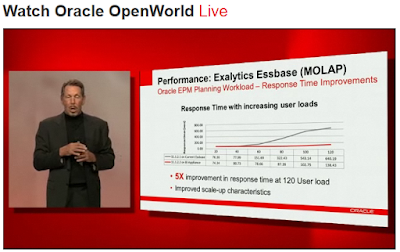
Performance graphs of Exalytics; average response time improvement: 18X


Average response time improvement with Exadata Oracle Database data source: 23X


In summary

And here's the video replay of the CEO keynote:

Tuesday, January 08, 2008

Oracle BI makes life easier....

In many cases people often question the return on investment or the impact of using business intelligence products in real life situations. Well here is a great example of Oracle's software making life much easier for thousands of travellers, me included, passing through Manchester Airport.

As an Oracle consultant I am a frequent visitor at Manchester Airport. Over the last year travelling has not been easy due to the "one bag" rule. Although I have become quiet skilled at packing a single suitcase with clothes, laptop computer and external hard drives just so I do not have to check in my luggage. Well not any more. Manchester Airport is one of the first UK airports to return to the normal "two pieces of hand luggage" rule and its all thanks to the forecasting capabilities provided by Oracle business intelligence product suite. Our products have allowed senior management at the airport to cope with the extra pressure of screening additional bags by helping identify future trends and to plan accordingly.

The full story is on the ComputerWeekly site and can be viewed directly from here:

http://www.computerweekly.com/Articles/2008/01/07/228771/manchester-airport-lifts-one-bag-rule-with-oracle.htm